Gulf Coast Permitting Pulse — June 2026
Every month, the U.S. Army Corps of Engineers issues hundreds of regulatory public notices across its Gulf and Southeast districts. Each one is an early, public signal — a project announcing itself before it shows up in the news. The problem is that the notices are scattered across district websites that don't talk to each other, written in different formats, and built for compliance, not insight.
This is the first edition of a monthly read that fixes that: the trends, the sector mix, and the projects worth watching — starting with the three districts I track most closely.
Permitting volume: three very different districts
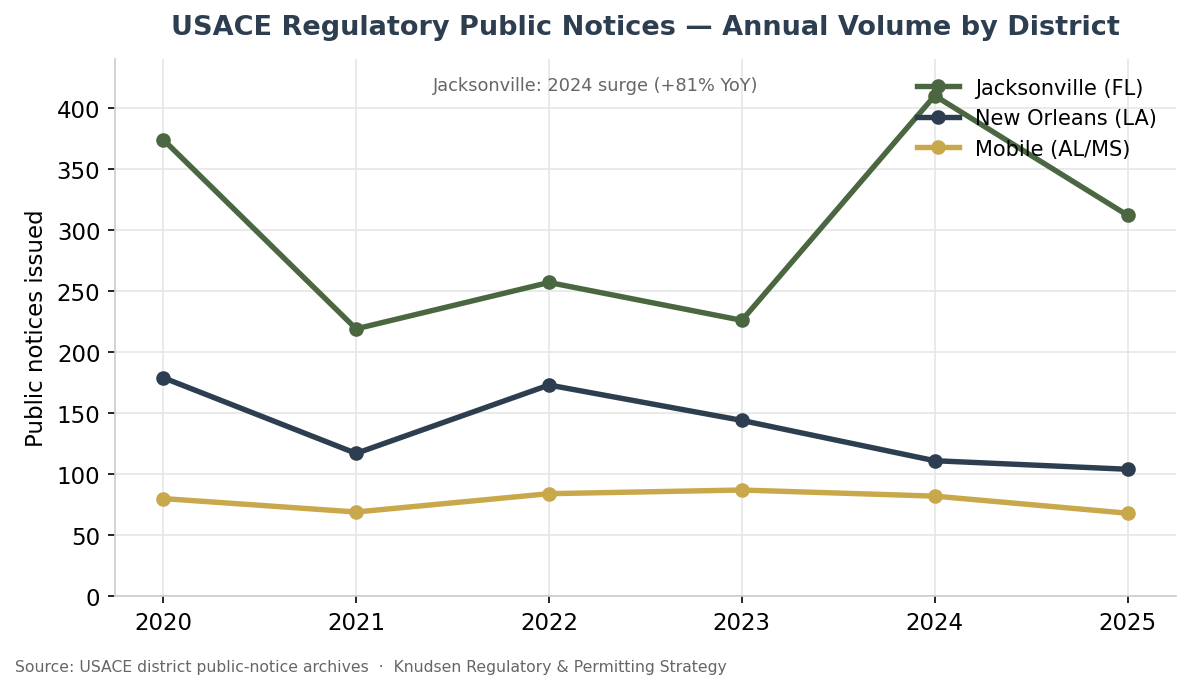
The first thing the data shows is scale. Jacksonville — covering Florida's development boom and coastal program — runs three to four times the volume of New Orleans, and spiked 81% in 2024 to 410 notices before easing in 2025. New Orleans has trended steadily downward since 2020, from 179 notices to 104. Mobile is the steady hand, hovering near 70–90 a year.
Volume isn't the same as opportunity. A single New Orleans notice for a 97-mile pipeline carries more economic weight than fifty Florida single-family-home notices. But the direction of travel matters: when a district's volume moves, it usually reflects something real about regional capital flows — and that's worth knowing before your competitors do.
What's actually being permitted
Counting notices only gets you so far. The value is in classifying them. Here's what New Orleans District has been permitting so far in 2026:
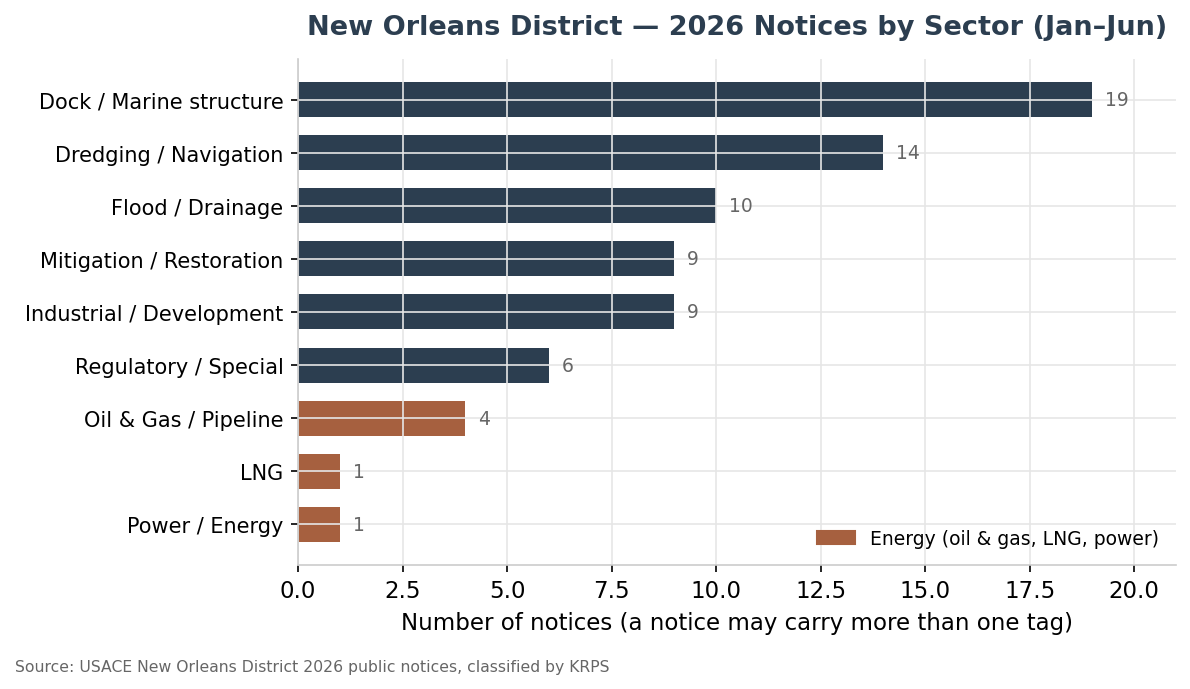
Marine structures and dredging dominate — docks, piers, barge fleets, mooring, and channel work — which is exactly what you'd expect in the lower Mississippi and Calcasieu corridors. Energy is a small slice by count, but it's the slice that moves markets. And that's the point: a volume chart hides the six notices that actually matter; a classified one surfaces them.
What I'm watching this month
- Shell — 97-mile pipeline, Fourchon Terminal to the Gulf. The largest single linear-infrastructure notice in the set. Signals continued Gulf gathering/midstream investment; watch for a multi-month review and organized comment.
- Tarpon Compressor Station, Creole Trail Pipeline (MP 34). Brownfield expansion supporting natural-gas transport in the LNG corridor — a quiet read on throughput plans.
- New 26-inch oil & gas pipeline + compressor station (7 miles). Greenfield linear build; routing and wetland impacts will set the schedule.
- LNG storage expansion ("to keep pace with growing demand for LNG storage solutions") — a direct value-chain signal.
- American Cruise Lines docking facility. Not energy, but a marine-tourism footprint worth noting on the river.
A public notice is the project announcing itself — quietly, in a place most people never look. The edge isn't the data. It's reading it before everyone else.
The bottom line
Across the Gulf and Southeast, permitting volume is stable-to-softening in Louisiana, surging-then-cooling in Florida, and steady in Alabama and Mississippi. But the headline number is a distraction. The signal is in the handful of energy and infrastructure projects moving through right now — and in knowing about them while the comment window is still open.
Go deeper than the chart
This monthly Pulse is the free view. Subscribers get the weekly brief: every new energy and infrastructure notice across the districts you choose, filtered to what matters, with my read on what each one signals — and a searchable database underneath it. Want it for your team?
Ask About the Weekly Brief